An Interview with Salam Hamdan:
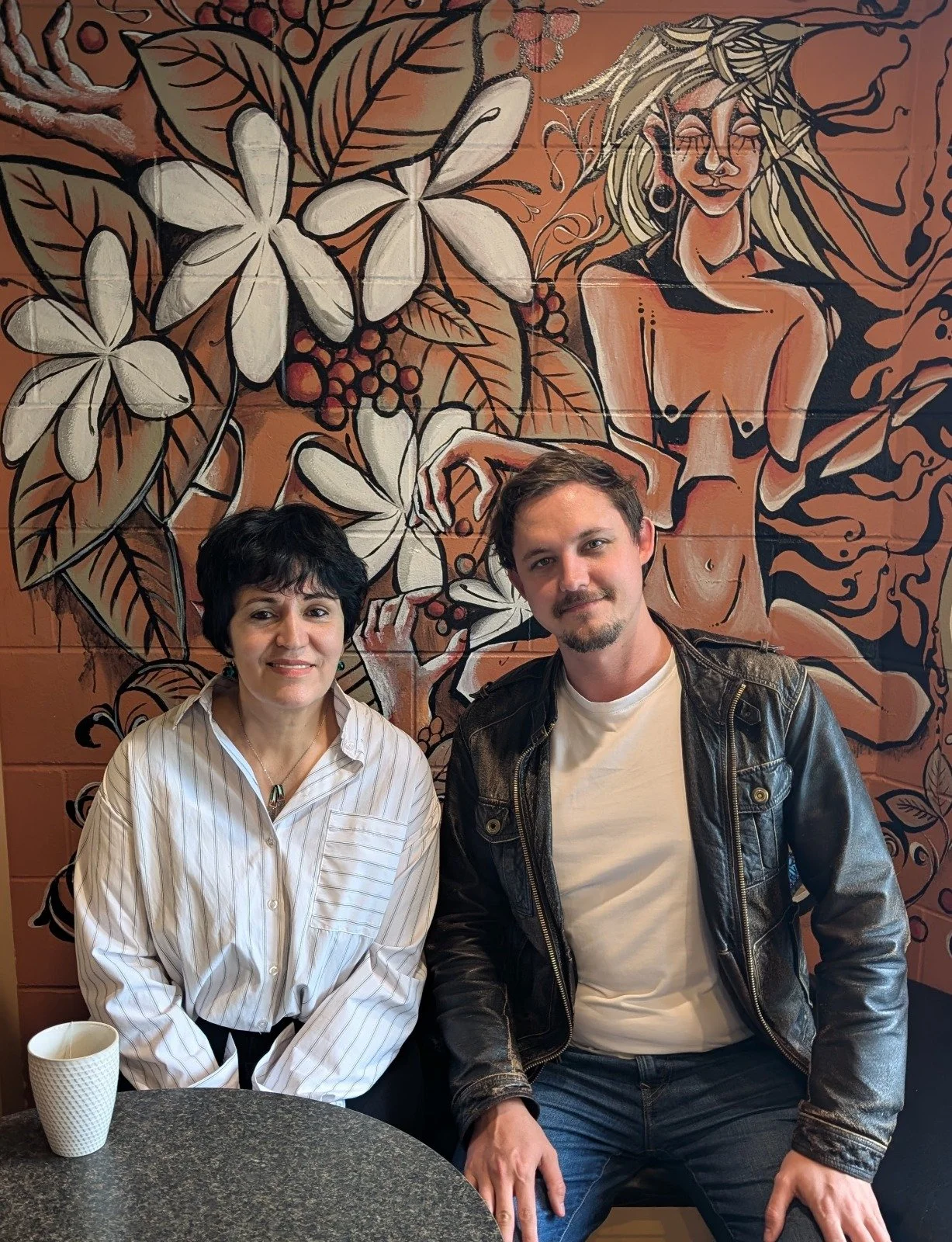
Visiting Victoria, BC from Ramallah, Salam Hamdan met with Cde. Tyson Strandlund in October for a long chat about Palestine, the Middle East, imperialism, and her family history. The following includes selected segments from that conversation edited for length and clarity.
Salam: I am Salam Hamdan. I’m from Ramallah, West Bank. My father, Abdel Majid Hamdan, was a co-founder of the Palestinian Communist Party back in 1982. At the time, the Palestinian communists were part of the Jordanian Communist Party, and before that, the Israeli Communist Party, before deciding to become independent. Together with a group of communist leaders in the Palestinian territories, they established their own party and separated from the Jordanian Communist Party.
Tyson: That was 1982 - is your dad still around?
S: My dad is still around, but he is no longer in the Party. He resigned - or retired a long time ago.
T: And were you involved in the Party?
S: I was. I was a member, for a bit. But then I had my political differences with the Party. I left the party at the dawn of the Oslo Agreement. The party changed their name to the People’s Party after the downfall of the socialist regimes, and they have changed their direction and ideology a little bit. We used to operate underground before that, and then after the establishment of the Palestinian Authority all the parties became legal, which was very controversial because we were still under the occupation. As soon as they became legalized, they lost their power and momentum - not so revolutionary. So I left the party when I was still young. I joined the party when I was 14 years old, and left when I was almost 24.
T: I actually used to be a member of the Central Committee of the Communist Party of Canada, and on the Central Executive Committee of the Young Communist League until a couple years ago. We had our own political, personal, and other differences, but obviously I remain a communist. But you mentioned Oslo - you left at that time over a disagreement with the party’s position?
S: It’s not only that, actually. There were many things. The policies of the party were very suppressive. We accepted that when we were operating underground because it had to be like that to maintain secrecy. But it maintained this strategy of work even after they became legalised. Because of this, and because they changed their ideology, I didn’t see much in common with them. I was studying in Prague at the time - it used to be part of a socialist country - and it was very disappointing when as a young communist you have this utopian idea about a socialist regime, and then you are confronted with lots of corruption and suppression. We discussed this with our Party and our Party wasn’t allowing these kinds of discussions. I mean, for many reasons I just… I’m still a communist, just not organised in a party. And I’m very well known as a communist in Ramallah.
T: That’s very interesting. What years were you going to school in Czechoslovakia?
S: I went by the end of 1987 until early 1994.
T: So you were there during the end of the socialist regime.
S: Yes, I was there, and I was really impacted by this, because one of the things the socialist regime had done for the Palestinians is to grant hundreds of university scholarships. That was really, really helpful at the time. Thousands of Palestinians studied in the socialist countries with that support. But when the regimes fell apart, they kicked us all out of the universities, especially in Czechoslovakia. In Russia, it was a bit different, as they allowed the students to complete their studies. In Czechoslovakia they asked us to pay. I was studying genetics at the time, which was very expensive. I couldn’t pay, so I had to quit the university. I worked for a couple of years to collect some money and went back to university in Palestine.
T: And you finished your degree there?
S: I finished my degree in something completely different, because we don’t have genetics, and we don’t have advanced laboratories. It’s not allowed under the occupation. So I completely switched and went into politics and international studies.
T: So was that the field you ended up working in?
S: Well, I mainly worked in the political field, political education with international organisations and with Palestinian NGOs. I started with Palestinian NGOs but I ended up with the Rosa Luxemburg Stiftung. It’s a left-wing German organisation associated with the Left Party, Die Linke. I worked for them for 13 years and we worked on political education working with the Palestinian left parties, with social movements, and with the workers unions.
T: Were you living in Germany at that time?
S: No, I was living in Palestine and working in their Palestinian branch. They had 24 or 25 regional offices around the world, including in New York at one point. Yeah, but I also had my differences with them because I mean, they started really, really well, but then the people started changing. in Roza al-Kasumber, at the head office. They wanted to become more independent from the party. You know this phenomenon of independence - they don't want to be attached to the parties. The ‘donor phenomenon,’ we call it, the NGOs around the world, which strips the parties from their power. The NGOs become independent, and then eventually become stronger than them, so they do not abide by the party. This is what happened with the Rosa Luxemburg Stiftung which started to recruit people who were not affiliated. They were not politicised - just technocrats - and those people weren’t committed to the ideology. They had a very orientalist perspective when it came to our part of the world. It had a taste of a colonialist approach. It was very, very difficult to handle. “We are the German people, we have studied you very thoroughly in the East, and we know what is best for you.” You know this mentality? It is very colonialist at its core.
T: Aha, I’m familiar with this tendency, yes. Colonial attitudes with some ‘left’ vocabulary to dress it up. So, you’ve been in Victoria for six months, you said? And you came here directly from Palestine. Obviously there’s no words to describe how terrible things have been there since October 7th. Can you tell me about what you experienced?
S: I mean, it was always terrible. In one of my talks here I told them that the Nakba never ended for the Palestinians. It started in 1948, but it kept dragging for decades, taking different forms and shapes. So it has always been hard for us, specifically in the last couple of years, with this genocide, and the so-called ‘war’ in Gaza. Things have also been extremely difficult in the West Bank, although it has been overshadowed. The Israelis found their perfect moment to do whatever they wish in the West Bank. So, they’ve confiscated huge amounts of land, and started the procedure of isolating the Palestinian inhabited areas - the cities, the villages, the refugee camps - surrounding them with military gates, with numerous checkpoints, with more and more military compounds, blocking roads and highways, making it very difficult to move from one place to another. This is the hardest thing in the West Bank. It has become very dissected, fragmented. And they started to create different realities in the different areas, detaching them from each other, subjecting them to different types of challenges. In some places they have the challenge of lack of water - they don’t give them enough water so they suffer from drought. In some places they are dense with Israeli settlers and they suffer from continuous settler attacks. So every area has its own challenges, and they’ve been working on this for a long time. First they separated Gaza from the West Bank, then they separated Jerusalem from the West Bank, and then they started chopping up and dissecting the West Bank, making the people no longer one homogenous society. They have created different levels of classes and different levels of relations with the occupation. We even have what is called ‘VIP checkpoints’ for businessmen - people who work for the Israelis and for big international organisations - who are granted special permits.
T: I can imagine this doesn’t do anything good for Palestinian national unity, this class division.
S: Not at all. I don’t like to say it, but I have to say it: they have crushed the national movement in Palestine. The two biggest parties, Fatah and Hamas, became associated with the Palestinian Authority and became the parties of the authority. They had a stake there, to maintain relatively acceptable relations with the Israelis, to keep things moving - salaries for the employees, facilitations for getting in and out of the country, etc. And then Hamas was left in Gaza, put under siege, at the beginning supported by the Israelis, in a way just to separate these two entities - you know, divide and rule. It’s the classic colonialist approach. Then Hamas was gradually turned into this militia. The left parties started operating on the ground - not secretive anymore - and they became linked to the Palestinian Authority. So, instead of the fees of the members - and this is one of the things I objected to from the Communist Party - instead of depending and relying on themselves, they fell under the umbrella of the PLO, which is ruled by the Palestinian Authority, and not the other way around. So, they had their share of money from the Palestinian Authority, which left them under the grip of Fatah, the ruling party, and stripped of power.
T: So, with the situation now, and the recent ceasefire, do you think this is something that could lead to a positive outcome? How do you see things going from here?
S: So far it’s not holding. They are still killing people. Israel does not want it to hold. They are making impossible demands. It’s the classic way Netanyahu maneuvers around these ‘deals’. Trump wants this deal for personal reasons. He wants to be the American president who solved this complex issue in the Middle East, and to be nominated in future for the Nobel Prize. And of course he’s under so much pressure in the United States to grant Israel huge amounts of money. But the Israelis do not want to end the war. The far-right that is ruling now in Israel, this is to them the historic moment to ethnically cleanse Palestine of Palestinians and create a ‘pure’ Jewish state. This is the main goal of the war in Gaza. It was never about the hostages. If you ask me my opinion about this deal, I really hope it holds, but I don’t see it holding. The humanitarian crisis is terrible, and it’s not only about the killing of people on a daily basis. The situation is horrific. There is nothing in Gaza - no fresh water, no food, no medicine, no vaccines for children, and disease is spreading everywhere and killing people in the thousands, and these people are not even recorded as having been killed in the war. But on the political level, there is nothing clear about it. When they talk about Gaza, no one talks about the Palestinians ruling themselves. It’s very foggy and scary.
T: As you mentioned, Gaza is totally destroyed, and the West Bank is very divided. What do you see as the most optimal long-term solution for the people of Palestine? Is there a possibility of a two state solution? Is it a one state solution? And is that even possible? It’s so shocking to hear the rhetoric that comes from regular working Israelis and their absolute hatred and ideological belief in this genocidal colonial entity. What do you think the future could, or ideally should look like?
S: If I had a map in front of me now, and we looked at all the Israeli settlements spread all over the West Bank - we have now approximately a million settlers, and we are just three million Palestinians in the West Bank - you would wonder how and where this Palestinian state would be initiated. But this is still more reasonable than talking about a one state solution. This is a utopia. This could be the best, one state for all the people from the river to the sea, a democratic state for everyone, that has nothing of the ‘national’ or about ideologies, but this is impossible considering the atmosphere in Israel right now. It’s not only Netanyahu and the group of far-right settler politicians around him. It’s a very mainstream culture that they have nurtured for at least 30 years. It has become a very religious form of zionism, where before it was a more secular form. There is now a solid belief amongst the masses that it has to be a pure Jewish state, that Arabs are inferior, and they don’t belong here. There is always this fear factor in Israel that has been very effective, using the Holocaust as a reminder - that this is going to happen to you again, that the Palestinians when they get this state are going to start killing you. That’s the future. It is a fantasy. It’s not realistic. But there are international powers who are interested in mentality in Israel. So it is impossible talking about a one state solution - at least in the near an actual, genuine solution, giving Palestinians at least part of their rights on part of their land. This makes the two-state solution more feasible, but the will for this doesn’t exist right now. Although many countries are acknowledging what’s happening in Palestine right now - including yours, which is very unusual - as a result of this immense popular pressure, the United States is not interested. We are starting to see slow changes in the universities, in important institutions, even in the United States. It may be that in future we will see such change that will facilitate this solution. But in short, a one state solution is impossible. Only the two-state solution is realistic for now, until one day in future this obsession about Jewish supremacy and the zionist ideology dies - is suffocated - and then there will be a possibility for a one-state solution for everybody, if we are still there.
T: Do you think that if the zionist regime more or less succeeds in expelling the Palestinians and achieve their dream of a pure Jewish state that they will stop there? We’ve seen how aggressive they’ve been towards Iran, Syria, Lebanon, etc. Where does their expansionist, imperialist policy end?
S: They are very clear about it when they talk about it on TV, their top politicians, their ministers, including the opposition - it’s not only Netanyahu and his group. They talk about the ultimate dream of the Israeli kingdom between the Euphrates and the Nile. And now their settler leaders are more forthcoming. They talk about it on your media, on the mainstream international media. Even Smotrich, the Minister of Finance, has said that ‘our flag states this reality, that Israel should stretch over this huge area of the Middle East.’ And Netanyahu was discussing this with Trump. When Trump started his presidency, he started saying ‘how small’ Israel was, and how ‘insecure’ it was because of this. It is very tiny in an ocean of ‘aggressive Arabs’ and that Israel must be bigger. When asked by journalists if he was referring to Gaza, he said ‘yes, and beyond!’ They have been very open and precise about their plan. ‘A piece of Syria, a piece of Egypt, even a piece of Saudi Arabia,’ and more. It is the zionist dream, and it is part of their doctrine.
T: So with that said, why do you think there hasn’t been more resistance from some of these neighbouring countries who are in fact very friendly with Israel? Like the Saudis, the Emirates etc.
S: Most of these regimes are holding there because of American protection. These are dictatorships which are holding against the will of their people. The Arab Spring was an ocean, getting rid of these dictatorships, and they managed to do so in certain countries, but in many cases they have been replaced with much worse people. At least those were ‘national’ dictatorships. The new ones are immediately associated with the Americans. They are completely controlled by the Americans. They are delusional. They believe that if they played low profile, that if they made peace agreements that Israel will respect that. That was the illusion before this far-right Israeli government, because they used ‘diplomatic’ talk. But now this government is speaking openly against these Arab countries, and they are getting worried. They still don’t believe it will happen, and that the Americans are going to stop the Israelis, and prohibit from expanding.
T: And of course recently we even saw the missile attack in Qatar targeting the leaders of Hamas during a diplomatic meeting.
S: That particular attack has actually raised lots of… worry. Let me put it like that. It has raised lots of worry in these regimes. Qatar is serving the Americans, it hosts the biggest American military bases in the region, and is trying to hold a neutral role and mediate between the Palestinians and the Israelis. And yet still it was attacked, so that is causing a lot of fear. But these are not progressive governments, and they are very much associated with the Americans, and believe they are protected by the Americans. Israel has created this situation in the Middle East - you have to give it to them, they are… genius - they have created this fragmentation. Iran, Shia, vs Saudi Arabia, Suni. The clashes between the two. And this is the prominent danger, Iran, not Israel. Israel was playing low profile with the Arabs for a long time. “We can be your allies in this,” that was the discourse from the Israelis. That’s how they achieved a number of agreements with these countries, who were made to believe they would be safer with the Israelis than with the Iranians. But things are changing now within the Arab countries. Not because they are less oblivious or more aware of what’s happening, but because the Israelis speak very clearly now, very bluntly, that their dream is far beyond the Jordanian river.
T: Do you think they’ve been emboldened in speaking so openly due to the lack of international action and response to the genocide in Palestine?
S: This impunity is not new to them. They have always been granted full impunity, and they act accordingly. They even film their crimes and send them to the world, and still nothing will happen to them. Even the Nazis in the past tried to hide their crimes, and the extent of it was uncovered after their downfall. It’s not about impunity, but about the far-right ruling regime that now has power in Israel. The religious form of zionism that now has the upper hand in Israel is very different. They don’t care about the world or what others think about them. They have a solid belief that everyone who is not Jewish is the enemy - everyone, even the Americans - and that they are the ‘chosen people,’ that this land was ‘promised by God,’ and that they are entitled to fulfil this promise. Many people are asking, ‘how are they shooting babies in the head, in the heart - infants - how do they do that?’ It is because they have this biblical belief that ethnic cleansing ‘their land’ is their ‘duty.’ They use biblical names for us - even Netanyahu - “amalek”. ‘Kill them, kill their animals, burn their trees, and take the land.’
T: It’s terrifying to see the way they’re able to dehumanise entire populations, and to see them dancing and singing as bombs are falling. You mentioned Nazi Germany - and you’re hardly the first I’ve heard make that comparison - which is something I studied a great deal as a historian. But one thing we see in that history is in fact substantial resistance to the Nazis within Germany, whereas in Israel… I don’t see that. Of course there are isolated instances, like people avoiding the draft, and the Communist Party of Israel in its opposition to the genocide, but it’s very small from what I’ve seen.
S: Yes, because the mood has changed drastically in the last 30 years. Israel has always been a colonial apparatus, it has always been brutal, but they had a different approach, a different discourse, and cared so much about their image. But this is not the case anymore. Israel started as, somehow a socialist country -
T: Right, the kibbutzes -
S: That’s why the Soviet Union - one of the things that burns my heart as a communist - was one of the first countries acknowledging Israel, thinking that this was going to be a socialist country in the Middle East. They started like that, but they went towards the open market. Living in Israel costs you so much, very much unlike how it was before. It was very tempting for Jews to go there. Before it was nearly free houses, nearly free this, and that, everything supported by the government. Now Tel Aviv is one of the most expensive cities to live in in the world. Victoria is outrageous when it comes to real estate, but Israel is far more than that. A studio in Tel Aviv would cost you millions. So things in Israel are changing on so many levels. With the rise of this new far-right religious movement, the people who were the ‘moderate’ Israelis, those on the left, the communists, they started leaving Israel. It is reported that hundreds of thousands have left Israel in the past ten years. Some of them have come here, to Canada. So, most of these people who would think about resisting this form of regime are not there anymore. Those that remain are completely silenced and terrorized. There is a fascistic atmosphere now in Israel. People do not dare to speak. Look at the Palestinians inside Israel. If you post a picture on social media that illustrates your sympathy with Gaza, you are going to prison - you are a traitor. The few voices that remain in Israel are completely suffocated.
T: I don’t want to take too much of your time, but I have one more question for you. What would your advice be for Palestine solidarity activists and movements here in Canada? What do you think they should be doing, and how should they be doing it?
S: I always find it tricky to be an outsider and give advice, because you don’t know the reality for those people. It’s the same when I see foreigners come to my country and they have their own suggestions of what is right and what is not right. But I respect their efforts, and I respect what they’re doing. However I believe they need to be much more united - and not only here in Canada, but everywhere, including Europe - to strengthen their discourses, to understand the realities, the cultures they’re living in, the backgrounds, the way they are living, the way they understand things, to be able to address the Palestinian cause in a more attractive and appealing way. If I were them, I would work to attract every single power, every single person that stands up for Palestine. But I know that this is not the case, neither here, nor in many countries around the world. I would be very alert - whether Palestinians or - to try and maintain this momentum or something close to this momentum around the world. Because agreements do not mean much at the end of the day. It’s not a solution. There won’t be an actual, real, genuine solution for Palestinians to have their rights without having an equivalent power to the Israelis. So yes, to maintain the momentum, to unite their efforts more, and to attract more and more people from the different solidarity groups - if I am in a place to give my advice.
T: I think this gives me lots to work with. I really appreciated this conversation, so thank you very much. I hope we meet again soon.
S: Thank you. I hope so too.